
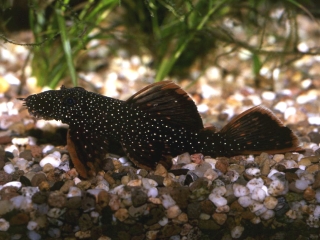
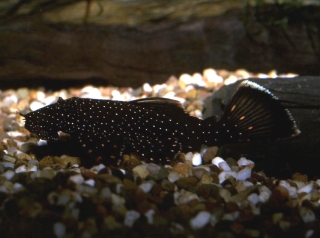
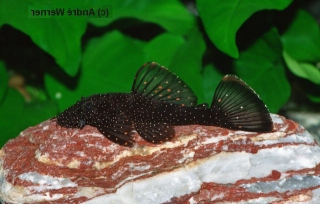
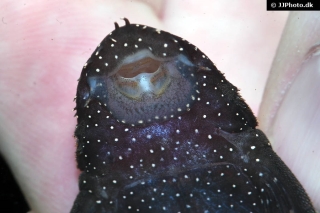
 Close-up of mouth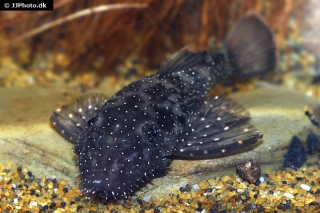
 All Fishes Data Sheet All Fishes Data Sheet | |
|---|---|
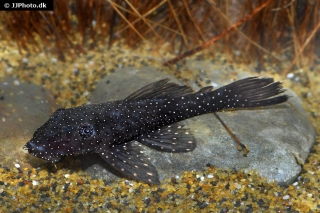
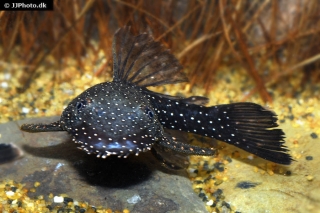
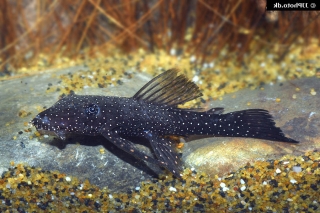
| Scientific Name | Ancistrus hoplogenys (Günther, 1864) |
| Common Names | L059, Orange Spotted Bristlenose Orangepletttet Antennesugemalle (Denmark), Rostfensancistrus (Sweden), Tuepfel-Antennenwels (Germany) |
| Type Locality | Rio Capin [= Capim], Pará State, Brazil. |
| Synonym(s) | Ancistrus alga, Ancistrus punctatus, Chaetostomus aculeatus alga, Chaetostomus aculeatus tectirostris, Chaetostomus cirrhosus punctata, Chaetostomus hoplogenys |
| Pronunciation | an SISS truss |
| Etymology | The name Ancistrus is derived from the Greek word agkistron, meaning hook, in reference to the interopercular odontodes that are hooked. Lorica, Loricare = cuirass of corslet of leather (a suit of armour made of leather). |
| Species Information | |
| Size | 158mm or 6.2" SL. Find near, nearer or same sized spp. |
| Identification | Mature males and sometimes females have soft tentacles (bushy fleshy growths) on the snout - this is unique to the genus Ancistrus. Mature males and sometimes females have soft tentacles (bushy fleshy growths) on the snout - this is unique to the genus Ancistrus. |
| Sexing | Males develop soft tentacles on the head and while sometimes females also do, it is never to the grand extent of those found on that of the conspecific male. Males develop soft tentacles on the head and while sometimes females also do, it is never to the grand extent of those found on that of the conspecific male. |
| Habitat Information | |
| Distribution | South America Amazon (click on these areas to find other species found there) Guyana Waters, Coastal Rivers of Guyanas, Essequibo (click on these areas to find other species found there) La Plata, Paraná, Paraguay (click on these areas to find other species found there) Amazon, Lower Amazon, Guamá, Puraquequara (click on these areas to find other species found there) Login to view the map. |
| IUCN Red List Category | Least Concern , a distribution map is available on the IUCN species page. Last assessed 2020. |
| pH | 6.0 - 7.0 |
| Temperature | 25.0-28.0°C or 77-82.4°F (Show species within this range) |
| Other Parameters | dH 5-12. |
| Husbandry Information | |
| Feeding | Ancistrus should be fed mainly on vegetarian foods. Prepared foods include algae wafers and spirulina based sinking food. Vegetables such as courgette/zucchini, and (English) cucumber are an excellent addition to the diet, along with the odd, small amount of more meaty foods. User data. |
| Compatibility | A good complement to most aquariums, they are not aggressive to other species. Males may fight over territory if kept in too small a tank. |
| Suggested Tankmates | Appropriate with most community fish that aren't overly big or aggressive. |
| Breeding | All Ancistrus species are cave-breeders, where the male looks after the eggs and young fry. |
| Breeding Reports | There is no breeding report. |
| Further Information | |
| Reference | Catalogue of the fishes in the British Museum v. 5, pp 247. |
| Wishlists | Love this species? Click the heart to add it to your wish list. There is no wish to keep this species. |
| Spotters | Spotted this species somewhere? Click the binoculars! There is but a single record of this fish being seen, view it. |
| More Resources | |
| Forum BBCode | |
 | Look up A. hoplogenys on PlanetCatfish.com |
 | Look up A. hoplogenys on Fishbase |
 | Look up A. hoplogenys on Encyclopedia of Life |
 | Look up A. hoplogenys on Global Biodiversity Information Facility |
| LFS label creator ARN ref:1.4.4.1806 | |
| Last Update | Sat Dec 25, 2010 10:17 am (Species record created: Thu Jan 01, 1970 1:00 am) |