 Summary of Chaetostoma Summary of Chaetostoma |
|---|
| New spp. / time |  | | | |  | | | | | | | | | | | 1750 | 1770 | 1790 | 1810 | 1830 | 1850 | 1870 | 1890 | 1910 | 1930 | 1950 | 1970 | 1990 | 2010 |
|
| Species | There are 82 "species" in our database. Chaetostoma formosae is the most commonly kept (k: 4). Chaetostoma formosae has the most images (i: 31). |
| Keepers | 3 species (3.7%) are being kept by registered keepers |
| Pronunciation | KATE oh STOW mah |
| Etymology | Greek, chaite = hair + Greek, stoma = mouth. |
| Identification | The genus Chaetostoma is not straightforward to identify, but as a general rule, the species has spines behind the gill-cover (interopercular odontodes), no plates on the abdomen, and aside from C. platyrhynchus also lack plates on the snout edge. Different from Ancistrus by not having fleshy tentacles on the snout. |
| Furniture | Well rounded stones stacked to replicate a river bottom and provide caves. |
| Sexing | The males have however a larger and broader head, slimmer ventral sides and disproportionately large pelvic fins. Perhaps the over-sized pelvic fins play a large role in the fertilization of the eggs. By inverting these over the clutch of eggs, they prevent the sperm cells being carried away by fast water current. |
| Breeding | Spawns in shallow, fast flowing water on the underneath of a flat object. Male, upside down, guards an adhesive clutch of eggs by covering it with his body. |
| Size | Smallest 49 mm, largest 300 mm, average 126mm, most commonly 120mm. All SL. |
| Distribution |
Login to view the map. |
| Genus Thumbnails |
|---|
|
| Most Kept Species |
|---|
| 1. | (57.14%) |
| 2. | (28.57%) |
| 3. | (14.29%) |

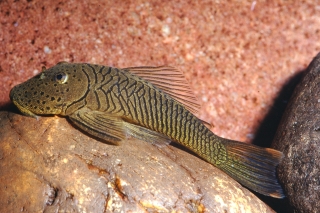
/1.jpg "Chaetostoma sp. (L402)")
`/1.jpg "Chaetostoma sp. `RIO ZUATA(ORINOCO)`")