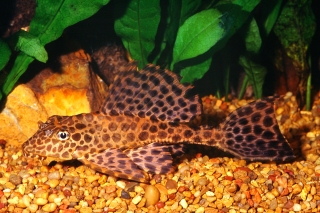
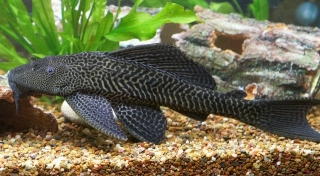
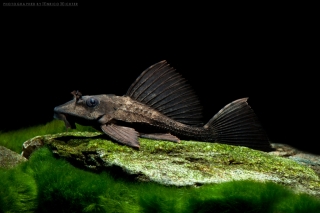
Summary of Pterygoplichthys Summary of Pterygoplichthys |
|---|
| New spp. / time |  | | |  | | | | | | | | | | | | 1750 | 1770 | 1790 | 1810 | 1830 | 1850 | 1870 | 1890 | 1910 | 1930 | 1950 | 1970 | 1990 | 2010 |
|
| Species | There are 23 "species" in our database. Pterygoplichthys gibbiceps is the most commonly kept (k: 5). Pterygoplichthys gibbiceps has the most images (i: 35). |
| Keepers | 3 species (13%) are being kept by registered keepers |
| Pronunciation | terry gop LICK thees |
| Etymology | Greek, pterygion, diminutive of pteryx = wing, fin + Greek, hoplon = weapon + Greek, ichthys = fish. |
| Identification | Pterygoplichthys can be identified by the number of rays in the dorsal fin. Ten or more dorsal rays (usually more than 10) indicates that it's a Pterygoplichthys. Most other plecos have 8 or fewer rays (in particular the larger Hypostomus species that are most likely to be confused with Pterygoplichthys). |
| Feeding | Omnivorous and a good algae eater, especially when young. |
| Tankmates | Almost any medium sized community fish. |
| Sexing | Comparison of the genital papilla in mature fish shows the differences in the sexes to the trained eye. In males this is a small yet thick stump which noticeably protrudes from the fish's undercarriage. In females it is less obvious and is recessed or lies flat with the body. |
| Breeding | Unreported in captivity, in nature, the male fish occupies a tunnel in soft river bank in which the eggs are laid and guarded. The egg mass of bright orange eggs contains thousands of eggs. |
| Size | Smallest 197 mm, largest 700 mm, average 381mm, most commonly 500mm. All SL. |
| Distribution |
Login to view the map. |
| Genus Thumbnails |
|---|
|
| Most Kept Species |
|---|
| 1. | (55.56%) |
| 2. | (22.22%) |
| 3. | (22.22%) |