
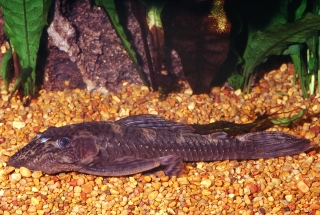
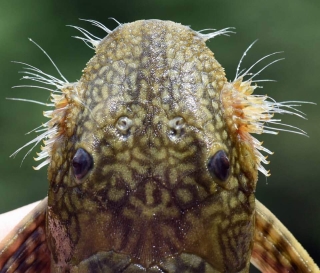
 Rio San Juan, Choco, Colombia
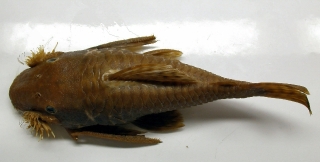 Preserved specimen - Dorsal view
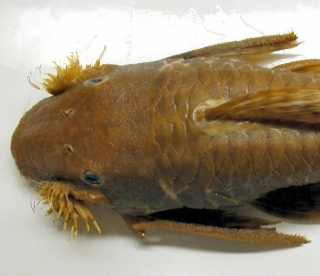 Preserved specimen - close-up of dorsal head view
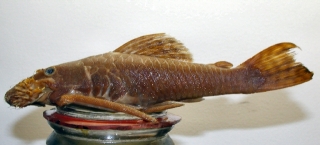 Preserved specimen - lateral view
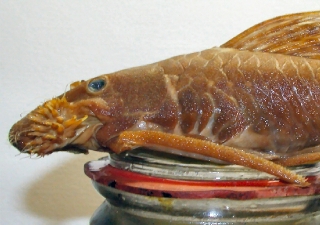 Preserved specimen - close-up of head
 All Fishes Data Sheet All Fishes Data Sheet | |
|---|---|
| Scientific Name | Lasiancistrus caucanus Eigenmann, 1912 |
| Common Name | |
| Type Locality | Cartago, Colombia. |
| Synonym(s) | Ancistrus planiceps, Hemiancistrus mayoloi, Lasiancistrus mayoloi, Lasiancistrus planiceps, Lasiancistrus volcanensis |
| Pronunciation | LASS ee an SISS truss |
| Etymology | Greek, lasios, -a, -on = hairy + Greek, agkistron = hook Lorica, Loricare = cuirass of corslet of leather (a suit of armour made of leather). |
| Species Information | |
| Size | 175mm or 6.9" SL. Find near, nearer or same sized spp. |
| Identification | Adult Lasiancistrus can be separated from all other loricariids by the presence of whisker-like odontodes on the cheeks. In addition, they have evertible cheek odontodes; three rows of plates on the caudal peduncle; and a modified, bar-shaped opercle. The caudal fin is slightly emarginate to forked, with the lower lobe longer than upper. Nuptial males have tentacules on the pectoral-fin spines longer than their associated odontodes; and transluscent tentacules on the snout that have odontodes associated with them. Nuptial males lack hypertrophied odontodes on top of the head and lack long, bristle-like odontodes on the leading edge of the pectoral-fin spine. Adult Lasiancistrus can be separated from all other loricariids by the presence of whisker-like odontodes on the cheeks. In addition, they have evertible cheek odontodes; three rows of plates on the caudal peduncle; and a modified, bar-shaped opercle. The caudal fin is slightly emarginate to forked, with the lower lobe longer than upper. Nuptial males have tentacules on the pectoral-fin spines longer than their associated odontodes; and transluscent tentacules on the snout that have odontodes associated with them. Nuptial males lack hypertrophied odontodes on top of the head and lack long, bristle-like odontodes on the leading edge of the pectoral-fin spine. |
| Sexing | Snout of nuptial males almost square (vs. rounded in females and juveniles). Adult males of most species (except Lasiancistrus tentaculatus) with whisker-like odontodes at anterolateral corner of snout; males of L. tentaculatus have tentacules instead of whisker-like odontodes along anterior margin of snout. Nuptial males have tentacules longer than their associated odontodes on the pectoral-fin spine. Snout of nuptial males almost square (vs. rounded in females and juveniles). Adult males of most species (except Lasiancistrus tentaculatus) with whisker-like odontodes at anterolateral corner of snout; males of L. tentaculatus have tentacules instead of whisker-like odontodes along anterior margin of snout. Nuptial males have tentacules longer than their associated odontodes on the pectoral-fin spine. |
| General Remarks | See also Armbruster, J.W. (2005). Neotrop. ichthyol., 3(4):549-569. See also Armbruster, J.W. (2005). Neotrop. ichthyol., 3(4):549-569. |
| Habitat Information | |
| Distribution | South America Colombia Caribbean Rivers, Magdalena, Cauca, Upper Cauca (click on these areas to find other species found there) Colombia Caribbean Rivers, Magdalena (click on these areas to find other species found there) Colombia Caribbean Rivers, Atrato (click on these areas to find other species found there) Colombia Pacific Rivers, San Juan (Colombia) (click on these areas to find other species found there) Panama Pacific Rivers, Tuira (click on these areas to find other species found there) Panama Pacific Rivers, Chepo, Bayano (Upper Chepo) (click on these areas to find other species found there) Colombia Caribbean Rivers, Magdalena, Middle Magdalena, San Bartolomé, Volcán (click on these areas to find other species found there) Login to view the map. |
| IUCN Red List Category | Least Concern , a distribution map is available on the IUCN species page. Last assessed 2019. |
| Husbandry Information | |
| Breeding Reports | There is no breeding report. |
| Further Information | |
| Reference | Indiana University Studies No. 16 [sic No. 8], pp 11. |
| Wishlists | Love this species? Click the heart to add it to your wish list. There is no wish to keep this species. |
| Spotters | Spotted this species somewhere? Click the binoculars! There are 3 records of this fish being seen, view them all. |
| More Resources | |
| Forum BBCode | |
 | Look up L. caucanus on PlanetCatfish.com |
 | Look up L. caucanus on Fishbase |
 | Look up L. caucanus on Encyclopedia of Life |
 | Look up L. caucanus on Global Biodiversity Information Facility |
| LFS label creator ARN ref:1.4.84.1258 | |
| Last Update | Sat Dec 25, 2010 10:17 am (Species record created: Thu Jan 01, 1970 1:00 am) |