
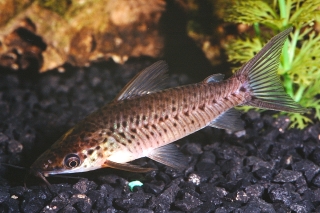
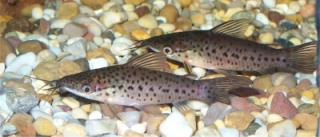
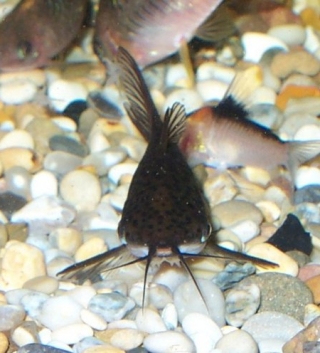
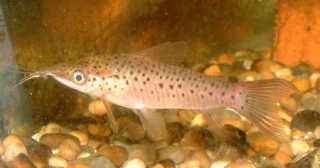
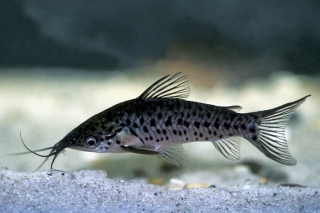
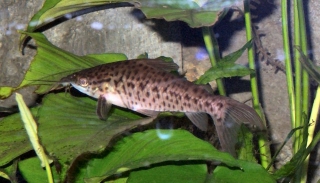
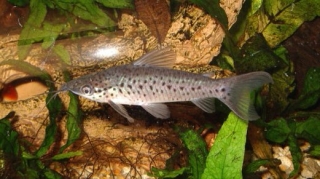
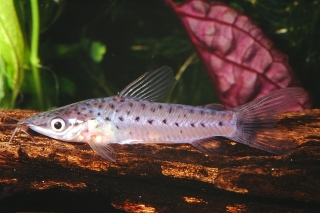
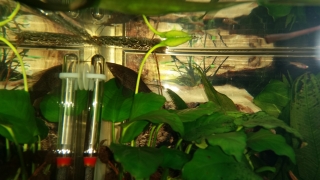
 Male tending bubblenest
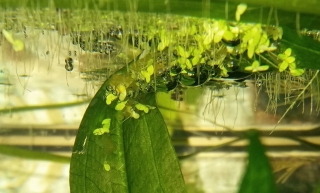 Close-up of bubblenest
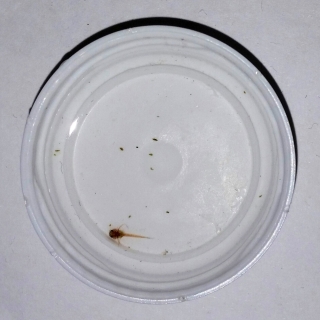 Fry
Fry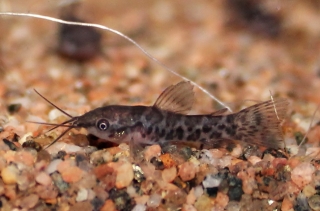 F1 Juvenile
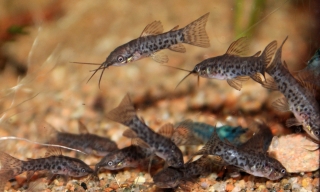 F1 Juveniles
 All Fishes Data Sheet All Fishes Data Sheet | |
|---|---|
| Scientific Name | Dianema longibarbis Cope, 1872 |
| Common Names | Porthole Catfish Malet Pansermalle (Denmark), Schwielenwels (Germany) |
| Type Locality | Río Ambyiacu, Peru. |
| Synonym(s) | Callichthys adspersus, Decapogon adspersus, Decapogon verissimi |
| Pronunciation | die ah NEE mah |
| Etymology | Dianema: From the Greek di-, meaning two and nema, meaning filament; in reference to the long maxillary barbels. Named after the genus Callichthys, which refers to the armour plates (Callum = hard skin; ichthys = fish) found in all members of this family. |
| Species Information | |
| Size | 82mm or 3.2" SL. Find near, nearer or same sized spp. |
| Sexing | In Dianema, Hoplosternum and Megalechis (but not in Callichthys), medial expansions of the coracoid bones are especially developed, covering most of the skin between the pectoral fins and sometimes overlapping at the midline in fully developed mature males (vs. not fully covering the abdominal skin and not overlapping in females). Mature males of Callichthys, Dianema, Hoplosternum, Lepthoplosternum, and Megalechis have a thick adipose body on the ventral surface of the pectoral fin. Mature females of Dianema, Hoplosternum and Megalechis have a small fold of skin on the external face of the leading pelvic-fin ray. In Dianema, Hoplosternum and Megalechis (but not in Callichthys), medial expansions of the coracoid bones are especially developed, covering most of the skin between the pectoral fins and sometimes overlapping at the midline in fully developed mature males (vs. not fully covering the abdominal skin and not overlapping in females). Mature males of Callichthys, Dianema, Hoplosternum, Lepthoplosternum, and Megalechis have a thick adipose body on the ventral surface of the pectoral fin. Mature females of Dianema, Hoplosternum and Megalechis have a small fold of skin on the external face of the leading pelvic-fin ray. |
| Habitat Information | |
| Distribution | South America Amazon (click on these areas to find other species found there) Amazon, Upper Amazon, Ampiyacu (click on these areas to find other species found there) Login to view the map. |
| IUCN Red List Category | Least Concern , a distribution map is available on the IUCN species page. Last assessed 2020. |
| pH | 5.8 - 7.8 |
| Temperature | 24.0-28.0°C or 75.2-82.4°F (Show species within this range) |
| Other Parameters | A hardy species that will adapt to most conditions. |
| Husbandry Information | |
| Breeding Reports | There is no breeding report. |
| Further Information | |
| Reference | Proceedings of the Academy of Natural Sciences of Philadelphia v. 23, pp 276, Pl. 7 (figs. 1, 1a-b). |
| Registered Keepers | There is but a single registered keeper, view all "my fish" data. |
| Wishlists | Love this species? Click the heart to add it to your wish list. There is no wish to keep this species. |
| Spotters | Spotted this species somewhere? Click the binoculars! There are 4 records of this fish being seen, view them all. |
| More Resources | |
| Forum BBCode | |
 | Look up D. longibarbis on PlanetCatfish.com |
 | Look up D. longibarbis on Fishbase |
 | Look up D. longibarbis on Encyclopedia of Life |
 | Look up D. longibarbis on Global Biodiversity Information Facility |
| LFS label creator ARN ref:1.1.55.280 | |
| Last Update | Fri Nov 04, 2022 10:03 am (Species record created: Thu Jan 01, 1970 1:00 am) |