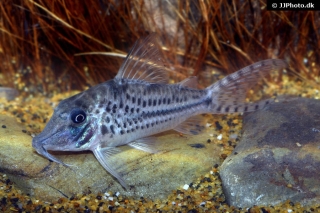
Summary of Corydoras Summary of Corydoras |
|---|
| New spp. / time |  | |  | | | | | | | | | | | | | 1750 | 1770 | 1790 | 1810 | 1830 | 1850 | 1870 | 1890 | 1910 | 1930 | 1950 | 1970 | 1990 | 2010 |
|
| Species | There are 90 "species" in our database. Corydoras vittatus is the most commonly kept (k: 1). Corydoras septentrionalis has the most images (i: 16). |
| Keepers | 1 species (1.1%) are being kept by registered keepers |
| Pronunciation | kor ee doh rass. |
| Etymology | Cory = helmet, doras = skin. In this case it was incorrectly used to mean armour (cuirasse) instead of skin in allusion to the dual rows of plates that run along the flanks of this genus. |
| Identification | Corydoras are identified by their twin rows of armour plates along the flanks and by having fewer than 10 dorsal fin rays. They are most commonly confused with the other genera in the sub-family, namely Brochis, Scleromystax and Aspidoras. |
| Feeding | Will readily accepted all prepared foods that reach the bottom of the aquarium such as tablets, granules and larger flakes. Live (or frozen) foods such as bloodworm, white worm, grindal worm (Enchytraeus), Daphnia and Tubifex are readily accepted and good for conditioning groups of fishes for spawning. |
| Compatibility | A peaceful, shoaling, community fish. |
| Furniture | Ideally substrate should be sand, but rounded gravel is an imperfect alternative. Avoid keeping over rough edged (chipped) gravel, this will increase this risk of damage the fishes barbels when it tries to dig. Substrate should be bordered with driftwood and aquatic plants leaving an open area for them to search for food and swim. The shade provided by overhanging rock work, arching bogwood, tall or floating plants are all that is required to settle these fishes. |
| Sexing | Females grow larger and are more full-bodied, this is best observed from above the fish. Males will typically have more pointed as opposed to more rounded fin tips as they mature. |
| Size | Smallest 40 mm, largest 80 mm, average 61mm, most commonly 65mm. All SL. |
| Distribution |
Login to view the map. |
| Genus Thumbnails |
|---|
|
| Most Kept Species |
|---|
| 1. | (100%) |