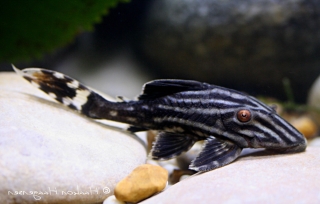
Summary of Panaque Summary of Panaque |
|---|
| New spp. / time |  | | | | | |  | | | | | | | | | 1750 | 1770 | 1790 | 1810 | 1830 | 1850 | 1870 | 1890 | 1910 | 1930 | 1950 | 1970 | 1990 | 2010 |
|
| Species | There are 18 "species" in our database. Panaque nigrolineatus is the most commonly kept (k: 1). Panaque schaeferi has the most images (i: 26). |
| Keepers | 1 species ( 5%) are being kept by registered keepers |
| Pronunciation | pan ah KAY. |
| Etymology | The generic epithet "panaque" is a Venezuelan common name for this fish. |
| Identification | The genus Panaque is identified by the teeth, which are spoon-shaped. This means that the teeth are noticeably wider at the tip than at the base. Other loricariidae have teeth that are similar width all the way from one end to the other. A second distinguishing feature is the lack of a buccal papilla, which is a "flap of skin" on the inside of the mouth. See pictures in this PDF on Pterygoplichthys. |
| Feeding | All Panaque appear to feed on wood, so wood should be present in the tank. They also take prepared algae wafers and fresh vegetables (zucchini, cucumber, peas, green beans) and tubers (potato, yams and similar). |
| Compatibility | Generally peaceful, but may defend their territory against conspecifics. |
| Furniture | Natural habitat is among fallen trees and wood-tangles. |
| Size | Smallest 278 mm, largest 600 mm, average 400mm, most commonly 400mm. All SL. |
| Distribution |
Login to view the map. |
| Genus Thumbnails |
|---|
|
| Most Kept Species |
|---|
| 1. | (100%) |