Summary of Sturisomatichthys Summary of Sturisomatichthys |
|---|
| New spp. / time |  | | | | | |  | | | | | | | | | 1750 | 1770 | 1790 | 1810 | 1830 | 1850 | 1870 | 1890 | 1910 | 1930 | 1950 | 1970 | 1990 | 2010 |
|
| Species | There are 16 "species" in our database. Sturisomatichthys aureus is the most commonly kept (k: 2). Sturisomatichthys aureus has the most images (i: 29). |
| Keepers | 1 species ( 6%) are being kept by registered keepers |
| Etymology | (German)Sturio=Sturgeon + (Greek) soma=body + (Greek) -ichthys=fish. |
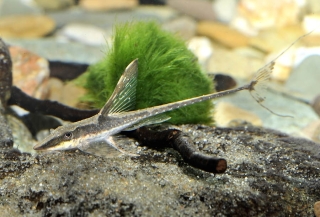
| Identification | Sturisoma and Sturisomatichthys can be difficult to tell apart. Older descriptions of the genera emphasized the length of the snout (elongated in Sturisoma), but this trait is not reliable across species. Recent analyses allow discrimination based on the abdominal plates, fin colors and lateral plates: Sturisoma has its central abdominal plates arranged in three clearly-defined longitudinal series; all fins (except sometimes pectoral fins) lack dark spots; and 20–21 lateral plates in median series. Sturisomatichthys has its central abdominal plates less organized, not arranged in clearly-defined longitudinal series; dark spots usually present on one or more of the dorsal-, pectoral-, pelvic, or anal-fins; and 15–18 lateral plates in median series. Furthermore, to date all Sturisoma are cis-Andean; most (but not all) Sturisomatichthys are trans-Andean. |
| Size | Smallest 150 mm, largest 254 mm, average 211mm, most commonly 180mm. All SL. |
| Distribution |
Login to view the map. |
| Genus Thumbnails |
|---|
|
| Most Kept Species |
|---|
| 1. | (100%) |