
 All Fishes Data Sheet All Fishes Data Sheet | |
|---|---|
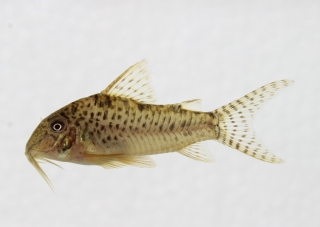
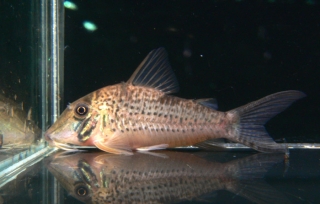
| Scientific Name | Corydoras areio Knaack, 2000 |
| Common Names | C070, Hump Cory Pukkelpansermalle (Denmark) |
| Type Locality | Streams of the Corr. Areio systems, in the vicinity of Vila Nova, East of Cuiaba, Mato Grosso, Brazil. |
| Synonym(s) | |
| Pronunciation | kor ee doh rass. |
| Etymology | Cory = helmet, doras = skin. In this case it was incorrectly used to mean armour (cuirasse) instead of skin in allusion to the dual rows of plates that run along the flanks of this genus. Named after the genus Callichthys, which refers to the armour plates (Callum = hard skin; ichthys = fish) found in all members of this family. |
| Species Information | |
| Size | 50mm or 2" SL. Find near, nearer or same sized spp. |
| Identification | Corydoras are identified by their twin rows of armour plates along the flanks and by having fewer than 10 dorsal fin rays. They are most commonly confused with the other genera in the sub-family, namely Brochis, Scleromystax and Aspidoras. Corydoras are identified by their twin rows of armour plates along the flanks and by having fewer than 10 dorsal fin rays. They are most commonly confused with the other genera in the sub-family, namely Brochis, Scleromystax and Aspidoras. |
| Sexing | Females grow larger and are more full-bodied, this is best observed from above the fish. Males will typically have more pointed as opposed to more rounded fin tips as they mature. Females grow larger and are more full-bodied, this is best observed from above the fish. Males will typically have more pointed as opposed to more rounded fin tips as they mature. |
| Habitat Information | |
| Distribution | South America La Plata, Paraná, Paraguay, Upper Paraguay (click on these areas to find other species found there) Login to view the map. |
| IUCN Red List Category | Least Concern , a distribution map is available on the IUCN species page. Last assessed 2018. |
| Husbandry Information | |
| Feeding | Will readily accepted all prepared foods that reach the bottom of the aquarium such as tablets, granules and larger flakes. Live (or frozen) foods such as bloodworm, white worm, grindal worm (Enchytraeus), Daphnia and Tubifex are readily accepted and good for conditioning groups of fishes for spawning. User data. |
| Furniture | Ideally substrate should be sand, but rounded gravel is an imperfect alternative. Avoid keeping over rough edged (chipped) gravel, this will increase this risk of damage the fishes barbels when it tries to dig. Substrate should be bordered with driftwood and aquatic plants leaving an open area for them to search for food and swim. The shade provided by overhanging rock work, arching bogwood, tall or floating plants are all that is required to settle these fishes. |
| Compatibility | A peaceful, shoaling, community fish. |
| Breeding Reports | There is no breeding report. |
| Further Information | |
| Reference | VDA--aktuell 2/2000, pp 47, Figs. |
| Wishlists | Love this species? Click the heart to add it to your wish list. There is no wish to keep this species. |
| Spotters | Spotted this species somewhere? Click the binoculars! There is but a single record of this fish being seen, view it. |
| More Resources | |
| Forum BBCode | |
 | Look up C. areio on PlanetCatfish.com |
 | Look up C. areio on Fishbase |
 | Look up C. areio on Encyclopedia of Life |
 | Look up C. areio on Global Biodiversity Information Facility |
| LFS label creator ARN ref:1.1.686.1895 | |
| Last Update | Fri Nov 04, 2022 10:03 am (Species record created: Thu Jan 01, 1970 1:00 am) |
Can't find it? Request addition.
Home | All Families | Synonyms | Common names | Image Updates