
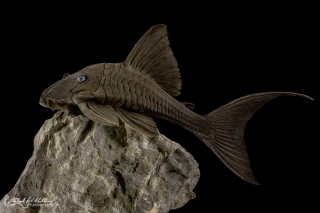
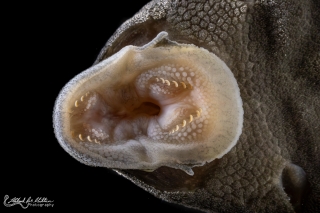
 Close-up of mouth
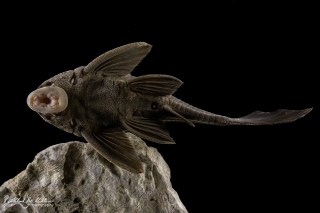 Dorsal view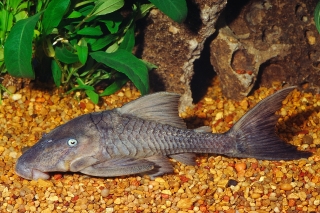
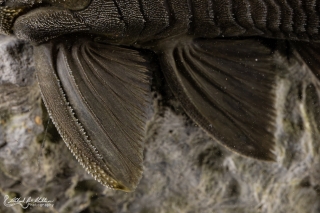 Close-up of paired fins
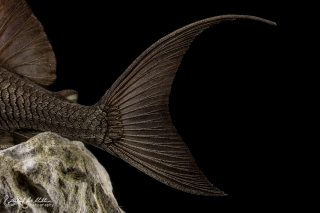 Close-up of caudal fin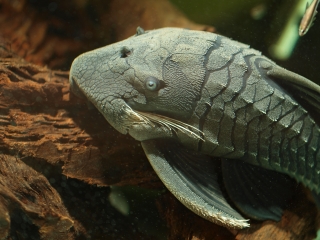
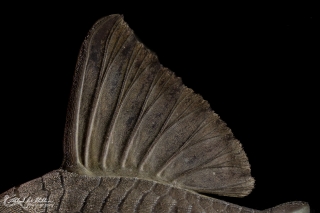 Close-up of dorsal fin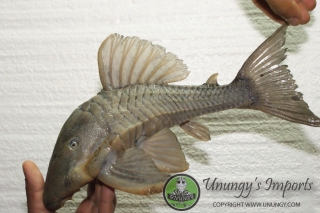
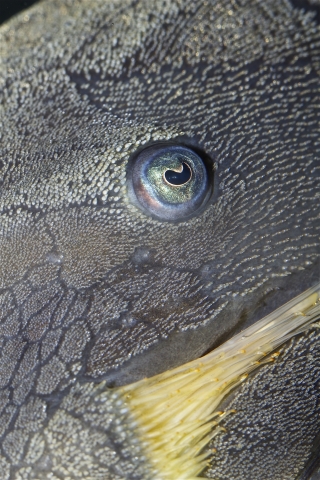 Close-up of eye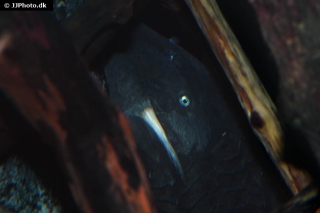
 All Fishes Data Sheet All Fishes Data Sheet | |
|---|---|
| Scientific Name | Panaque cochliodon (Steindachner, 1879) |
| Common Names | Blue Eyed Royal Pleco Blue Eyed Pleco, Safirøjet Kongesugemalle (Denmark) |
| Type Locality | Río Cauca, Magdalena River drinage, Colombia. |
| Synonym(s) | |
| Pronunciation | pan ah KAY. |
| Etymology | The generic epithet "panaque" is a Venezuelan common name for this fish. Lorica, Loricare = cuirass of corslet of leather (a suit of armour made of leather). |
| Species Information | |
| Size | 300mm or 11.8" SL. Find near, nearer or same sized spp. |
| Identification | The genus Panaque is identified by the teeth, which are spoon-shaped. This means that the teeth are noticeably wider at the tip than at the base. Other loricariidae have teeth that are similar width all the way from one end to the other. A second distinguishing feature is the lack of a buccal papilla, which is a "flap of skin" on the inside of the mouth. See pictures in this PDF on Pterygoplichthys. The genus Panaque is identified by the teeth, which are spoon-shaped. This means that the teeth are noticeably wider at the tip than at the base. Other loricariidae have teeth that are similar width all the way from one end to the other. A second distinguishing feature is the lack of a buccal papilla, which is a "flap of skin" on the inside of the mouth. See pictures in this PDF on Pterygoplichthys. |
| Habitat Information | |
| Distribution | South America Colombia Caribbean Rivers, Magdalena (click on these areas to find other species found there) Colombia Caribbean Rivers, Magdalena, Cauca (click on these areas to find other species found there) Login to view the map. |
| IUCN Red List Category | Near Threatened , a distribution map is available on the IUCN species page. Last assessed 2014. |
| Husbandry Information | |
| Feeding | All Panaque appear to feed on wood, so wood should be present in the tank. They also take prepared algae wafers and fresh vegetables (zucchini, cucumber, peas, green beans) and tubers (potato, yams and similar). User data. |
| Furniture | Natural habitat is among fallen trees and wood-tangles. |
| Compatibility | Generally peaceful, but may defend their territory against conspecifics. |
| Breeding Reports | There is no breeding report. |
| Further Information | |
| Reference | Anzeiger der Kaiserlichen Akademie der Wissenschaften, Wien, Mathematisch-Naturwissenschaftliche Classe v. 16 (no. 18) (for 17 July 1879), pp 194. |
| Wishlists | Love this species? Click the heart to add it to your wish list. There is no wish to keep this species. |
| Spotters | Spotted this species somewhere? Click the binoculars! There are 8 records of this fish being seen, view them all. |
| More Resources | |
| Forum BBCode | |
 | Look up P. cochliodon on PlanetCatfish.com |
 | Look up P. cochliodon on Fishbase |
 | Look up P. cochliodon on Encyclopedia of Life |
 | Look up P. cochliodon on Global Biodiversity Information Facility |
| LFS label creator ARN ref:1.4.27.2295 | |
| Last Update | Sat Dec 25, 2010 10:17 am (Species record created: Thu Jan 01, 1970 1:00 am) |