
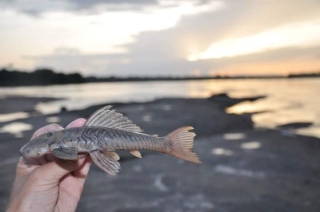
 All Fishes Data Sheet All Fishes Data Sheet | |
|---|---|
| Scientific Name | Chaetostoma vasquezi Lasso & Provenzano, 1998 |
| Common Name | |
| Type Locality | Raudales del Caño El Cambur, tributary of Rio Caura, Bolívar State, Venezuela. |
| Synonym(s) | |
| Pronunciation | KATE oh STOW mah |
| Etymology | Greek, chaite = hair + Greek, stoma = mouth. Lorica, Loricare = cuirass of corslet of leather (a suit of armour made of leather). |
| Species Information | |
| Size | 187mm or 7.4" SL. Find near, nearer or same sized spp. |
| Identification | The genus Chaetostoma is not straightforward to identify, but as a general rule, the species has spines behind the gill-cover (interopercular odontodes), no plates on the abdomen, and aside from C. platyrhynchus also lack plates on the snout edge. Different from Ancistrus by not having fleshy tentacles on the snout. The genus Chaetostoma is not straightforward to identify, but as a general rule, the species has spines behind the gill-cover (interopercular odontodes), no plates on the abdomen, and aside from C. platyrhynchus also lack plates on the snout edge. Different from Ancistrus by not having fleshy tentacles on the snout. |
| Sexing | The males have however a larger and broader head, slimmer ventral sides and disproportionately large pelvic fins. Perhaps the over-sized pelvic fins play a large role in the fertilization of the eggs. By inverting these over the clutch of eggs, they prevent the sperm cells being carried away by fast water current. The males have however a larger and broader head, slimmer ventral sides and disproportionately large pelvic fins. Perhaps the over-sized pelvic fins play a large role in the fertilization of the eggs. By inverting these over the clutch of eggs, they prevent the sperm cells being carried away by fast water current. |
| Habitat Information | |
| Distribution | South America Orinoco, Lower Orinoco, Caroni (click on these areas to find other species found there) Orinoco, Lower Orinoco, Caura (click on these areas to find other species found there) Orinoco, Lower Orinoco (click on these areas to find other species found there) Login to view the map. |
| IUCN Red List Category | Least Concern , a distribution map is available on the IUCN species page. Last assessed 2017. |
| Other Parameters | Both the Caura and Caroní rivers are blackwater rivers, with pH 4.7-6.9 and conductivity that varies between 6.2 to 22.4 µs/cm. |
| Husbandry Information | |
| Furniture | Well rounded stones stacked to replicate a river bottom and provide caves. |
| Breeding | Spawns in shallow, fast flowing water on the underneath of a flat object. Male, upside down, guards an adhesive clutch of eggs by covering it with his body. |
| Breeding Reports | There is no breeding report. |
| Further Information | |
| Reference | Memoria, Fundación La Salle de Ciencias Naturales v. 57 (no. 147) (for Jan.-June 1997), pp 55, Fig. |
| Wishlists | Love this species? Click the heart to add it to your wish list. There is no wish to keep this species. |
| Spotters | Spotted this species somewhere? Click the binoculars! There is but a single record of this fish being seen, view it. |
| More Resources | |
| Forum BBCode | |
 | Look up C. vasquezi on PlanetCatfish.com |
 | Look up C. vasquezi on Fishbase |
 | Look up C. vasquezi on Encyclopedia of Life |
 | Look up C. vasquezi on Global Biodiversity Information Facility |
| LFS label creator ARN ref:1.4.26.6771 | |
| Last Update | Sat Dec 25, 2010 10:17 am (Species record created: Thu Jan 01, 1970 1:00 am) |
Can't find it? Request addition.
Home | All Families | Synonyms | Common names | Image Updates