
 Close-up of head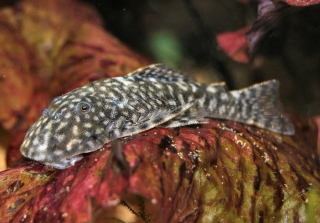
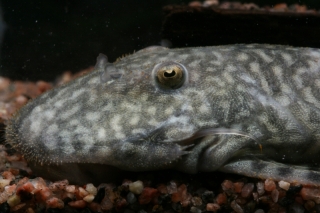
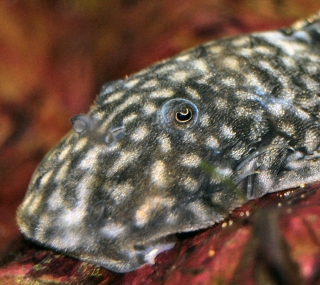 Close-up of head
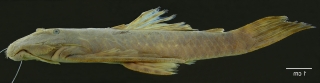
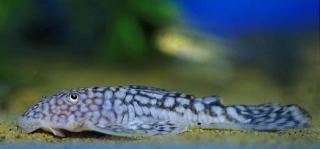 Juvenile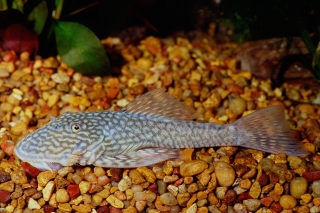
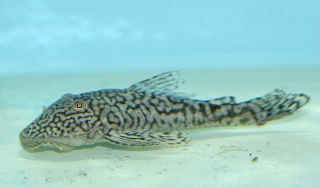
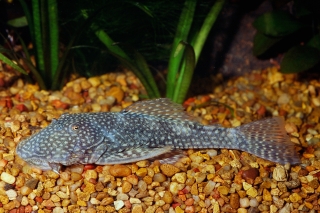
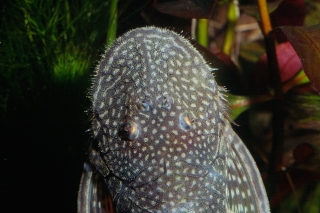 Close-up of dorsal view of head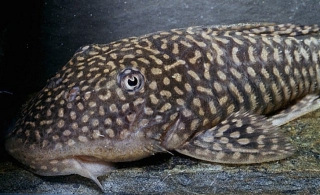
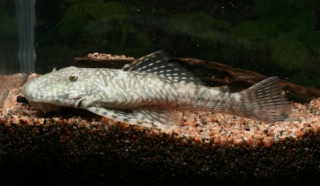
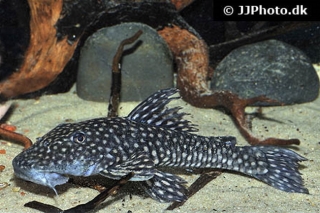
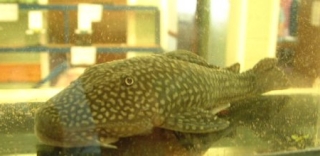 Adult
Adult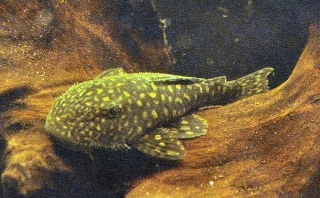 Showing odontodal growth around muzzle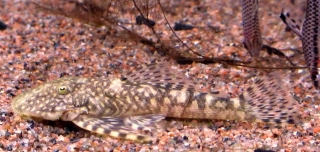
 All Fishes Data Sheet All Fishes Data Sheet | |
|---|---|
| Scientific Name | Dolichancistrus fuesslii (Steindachner, 1911) |
| Common Names | L225, Big White Spot Rubbernose Pleco L442, Big White Spot Bulldog Pleco, Marmor-gumminæse (Denmark) |
| Type Locality | Sosomoco, Colombia, elevation 800 meters. |
| Synonym(s) | Ancistrus fuesslii, Ancistrus fusslii, Lasiancistrus fuessi, Lasiancistrus fuessli, Lasiancistrus fuesslii |
| Pronunciation | dolly can SISS truss |
| Etymology | Greek, dolichos = long + Greek, agkistron = hook - meaning "Long Ancistrus". Lorica, Loricare = cuirass of corslet of leather (a suit of armour made of leather). |
| Species Information | |
| Size | 131mm or 5.2" SL. Find near, nearer or same sized spp. |
| Identification | Dolichancistrus is similar to Leptoancistrus, Cordylancistrus and Chaetostoma. Dolichancistrus is differentiated from Leptoancistrus by the presence of the adipose and anal fins (vs. their absence); from Cordylancistrus and Chaetostoma by the presence of pectoral-fin spines in mature males longer than those in adult females and immatures of both sexes (vs. the pectoral spines of equal length in both sexes); and from most species of Chaetostoma in having a plated snout (vs. naked). Dolichancistrus differs from Chaetostoma platyrhynchus in having the hyperthrophied cheek odontodes evertible to more than 90º (vs. evertible only to approximately 30-40º) and in bearing hyperthrophied cheek odontodes that are distally recurved (vs. odontodes straight along their entire length). Dolichancistrus is similar to Leptoancistrus, Cordylancistrus and Chaetostoma. Dolichancistrus is differentiated from Leptoancistrus by the presence of the adipose and anal fins (vs. their absence); from Cordylancistrus and Chaetostoma by the presence of pectoral-fin spines in mature males longer than those in adult females and immatures of both sexes (vs. the pectoral spines of equal length in both sexes); and from most species of Chaetostoma in having a plated snout (vs. naked). Dolichancistrus differs from Chaetostoma platyrhynchus in having the hyperthrophied cheek odontodes evertible to more than 90º (vs. evertible only to approximately 30-40º) and in bearing hyperthrophied cheek odontodes that are distally recurved (vs. odontodes straight along their entire length). |
| Habitat Information | |
| Distribution | South America Orinoco, Middle Orinoco, Meta (click on these areas to find other species found there) Venezuela Caribbean Waters, Tocuyo, Urama (click on these areas to find other species found there) Login to view the map. |
| IUCN Red List Category | Near Threatened , a distribution map is available on the IUCN species page. Last assessed 2020. |
| Husbandry Information | |
| Breeding | Unreported in the aquarium. |
| Breeding Reports | There is no breeding report. |
| Further Information | |
| Reference | Anzeiger der Kaiserlichen Akademie der Wissenschaften in Wien, Mathematisch-Naturwissenschaftlichen Klasse v. 48 (no. 17) (for 6 July 1911), pp 373. |
| Wishlists | Love this species? Click the heart to add it to your wish list. There is no wish to keep this species. |
| Spotters | Spotted this species somewhere? Click the binoculars! There are 8 records of this fish being seen, view them all. |
| More Resources | |
| Forum BBCode | |
 | Look up D. fuesslii on PlanetCatfish.com |
 | Look up D. fuesslii on Fishbase |
 | Look up D. fuesslii on Encyclopedia of Life |
 | Look up D. fuesslii on Global Biodiversity Information Facility |
| LFS label creator ARN ref:1.4.59.2263 | |
| Last Update | Sat Dec 25, 2010 10:17 am (Species record created: Thu Jan 01, 1970 1:00 am) |