
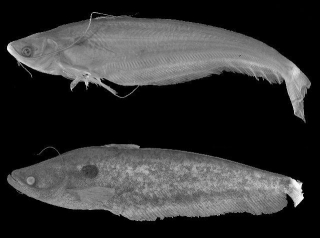
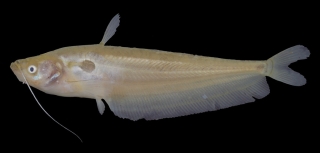
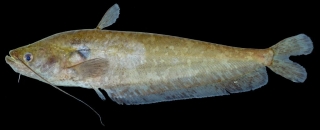
 Comparison of O. bimaculatus (above) and O. siluroides (below)
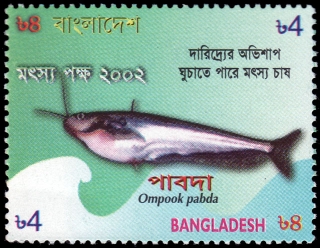 Stamp
Stamp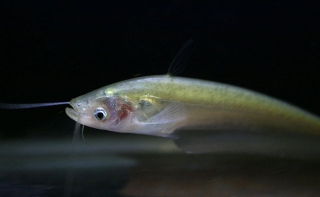 Collected from the Tambraparani River, Tamil Nadu, India
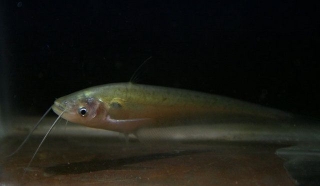 Collected from the Tambraparani River, Tamil Nadu, India
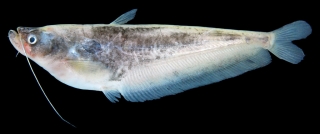
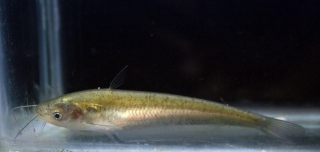 Collected from the Tambraparani River, Tamil Nadu, India
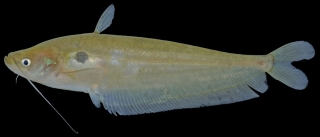
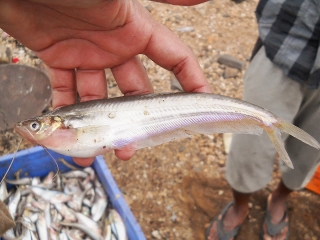 Tungabhadra River, Karnataka, India
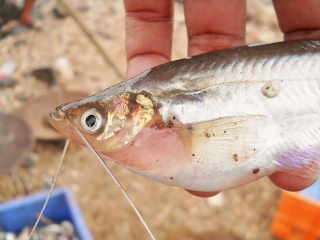 Tungabhadra River, Karnataka, India
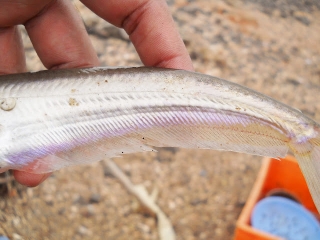 Tungabhadra River, Karnataka, India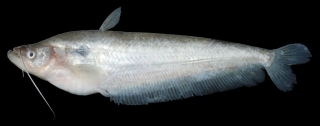
 All Fishes Data Sheet All Fishes Data Sheet | |
|---|---|
| Scientific Name | Ompok bimaculatus (Bloch, 1794) |
| Common Names | Two Spot Glass Catfish Toplettet Glasmalle (Denmark) |
| Type Locality | Tranquebar [Tharangambadi], India. |
| Synonym(s) | Callichrous bimaculatus, Callichrous chechra, Callichrous gangeticus, Callichrous macrophthalmus, Callichrous nebulosus, Callichrus affinis, Callichrus nebulosus, Ompak bimaculatus, Ompok siluroides, Phalacronotus siluroides, Pseudosilurus bimaculatus, Pseudosilurus macropthalmos, Pseudosilurus macropthalmus, Silurus affinis, Silurus bimaculatus, Silurus chechra, Silurus duda, Silurus microcephalus, Silurus mysoricus, Silurus nebulosus, Wallago bimaculatus, Wallago microcephalus |
| Pronunciation | Awm pok |
| Etymology | The etymology of Ompok is unclear. It is believed to be a corruption of the Indonesian name for mid-sized silurid catfishes, limpok. |
| Species Information | |
| Size | 450mm or 17.7" SL. Find near, nearer or same sized spp. |
| Identification | The catfish genus Ompok La Cepède, 1803, consists of medium-sized silurid fishes found in inland waters throughout South and Southeast Asia. The genus is traditionally diagnosed by the presence of a short dorsal fin with 4 rays, strongly forked caudal fin, subcutaneous eye that is set immediately posterior to the mouth rictus and two patches of palatal teeth (Weber & de Beaufort, 1913). Bornbusch (1995) showed that Ompok, as currently understood, is probably paraphyletic. The catfish genus Ompok La Cepède, 1803, consists of medium-sized silurid fishes found in inland waters throughout South and Southeast Asia. The genus is traditionally diagnosed by the presence of a short dorsal fin with 4 rays, strongly forked caudal fin, subcutaneous eye that is set immediately posterior to the mouth rictus and two patches of palatal teeth (Weber & de Beaufort, 1913). Bornbusch (1995) showed that Ompok, as currently understood, is probably paraphyletic. |
| Habitat Information | |
| Distribution | Continental Europe to Asia, introduced into the UK Thailand Waters (click on these areas to find other species found there) Cambodia waters (click on these areas to find other species found there) Pacific, Malaysia Waters (click on these areas to find other species found there) Indian waters (click on these areas to find other species found there) Bangladesh Waters (click on these areas to find other species found there) Pacific, Greater Sunda Island Rivers, Borneo Waters (click on these areas to find other species found there) Login to view the map. |
| IUCN Red List Category | Near Threatened , a distribution map is available on the IUCN species page. Last assessed 2009. |
| pH | 6.4 - 7.4 |
| Temperature | 20.0-26.0°C or 68-78.8°F (Show species within this range) |
| Husbandry Information | |
| Breeding | Unreported in the aquarium. |
| Breeding Reports | There is no breeding report. |
| Further Information | |
| Reference | Naturgeschichte der ausländischen Fische v. 8, pp 24, Pl. 364. |
| Wishlists | Love this species? Click the heart to add it to your wish list. There is no wish to keep this species. |
| Spotters | Spotted this species somewhere? Click the binoculars! There are 3 records of this fish being seen, view them all. |
| More Resources | |
| Forum BBCode | |
 | Look up O. bimaculatus on PlanetCatfish.com |
 | Look up O. bimaculatus on Fishbase |
 | Look up O. bimaculatus on Encyclopedia of Life |
 | Look up O. bimaculatus on Global Biodiversity Information Facility |
| LFS label creator ARN ref:1.7.113.792 | |
| Last Update | Thu Jan 01, 1970 1:00 am (Species record created: Thu Jan 01, 1970 1:00 am) |