
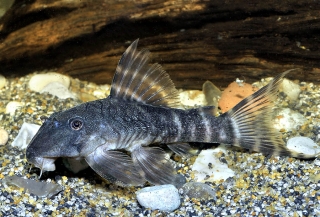
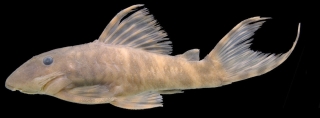
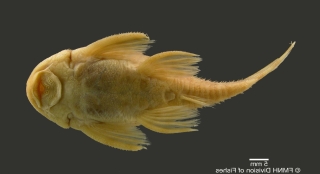
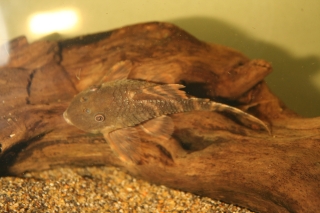
 Ventral view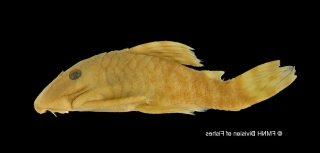
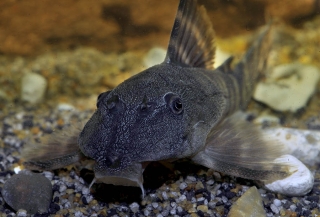
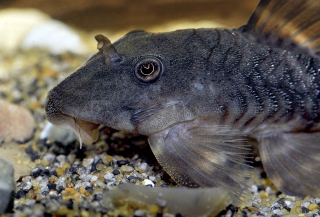
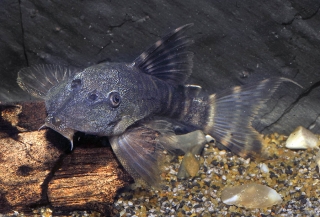
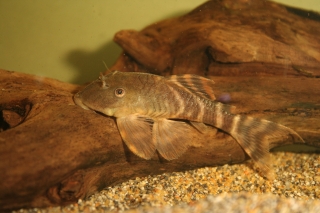
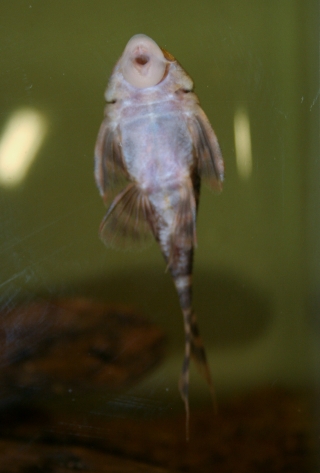
 Dorsal view
 Ventral view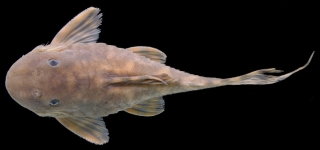
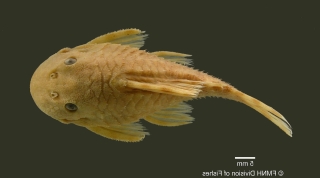 Dorsal view of preserved specimen
 All Fishes Data Sheet All Fishes Data Sheet | |
|---|---|
| Scientific Name | Panaqolus gnomus (Schaefer & Stewart, 1993) |
| Common Name | |
| Type Locality | Río Cushuimi at Cushuimi, about 2°39'S, 77°43'W, upper Río Morona - Marañón basin, Ecuador, elevation 300+ meters. |
| Synonym(s) | Panaque gnomus |
| Pronunciation | pan ack oh luss |
| Etymology | Panaqolus: Inelegantly derived from the indigenous term Panaque and in a form that infers a smaller size than that genus. Lorica, Loricare = cuirass of corslet of leather (a suit of armour made of leather). |
| Species Information | |
| Size | 71mm or 2.8" SL. Find near, nearer or same sized spp. |
| Sexing | Like all members of the genus, males grow elongated interopercular odontodes during the breeding season. Males develop noticeable odontodes along the dorsum (back of the body) as well. Males develop small pointed genital papillae, whereas mature females will have large, rounded, swollen papillae. Additionally, gravid females have noticeably wider bodies between the pectoral and pelvic fins when viewed from above, compared to males. Like all members of the genus, males grow elongated interopercular odontodes during the breeding season. Males develop noticeable odontodes along the dorsum (back of the body) as well. Males develop small pointed genital papillae, whereas mature females will have large, rounded, swollen papillae. Additionally, gravid females have noticeably wider bodies between the pectoral and pelvic fins when viewed from above, compared to males. |
| Habitat Information | |
| Distribution | South America Amazon, Upper Amazon, Marañón, Upper Marañón (click on these areas to find other species found there) Amazon, Upper Amazon, Marañón, Pastaza (click on these areas to find other species found there) Login to view the map. |
| IUCN Red List Category | Least Concern , a distribution map is available on the IUCN species page. Last assessed 2014. |
| Husbandry Information | |
| Feeding | This genus feeds on wood, and should have several pieces, preferably several kinds of wood to chew on. Aside from wood, a mainly vegetarian diet is recommended, prepared food such as algae wafers and fresh vegetables, such as courgette (zucchini) and tubers such as potato or sweet potato (yams). User data. |
| Furniture | Rock piles are optional and wood tangles are a must. Plants are not vital and will be nibbled or destroyed. |
| Suggested Tankmates | Works well with most types of peaceful community fish. Can be somewhat territorial towards conspecifics, but given enough hiding spaces, a group can be kept in a suitable size aquarium - roughly requiring a 30 x 30cm area per fish. |
| Breeding | A cave breeder, the male looks after the eggs and fry until the fry are ready to fend for themselves as miniature copies of the adults. |
| Breeding Reports | There is no breeding report. |
| Further Information | |
| Reference | Ichthyological Exploration of Freshwaters v. 4 (no. 4), pp 333, Fig. 17. |
| Wishlists | Love this species? Click the heart to add it to your wish list. There is no wish to keep this species. |
| Spotters | Spotted this species somewhere? Click the binoculars! There are 3 records of this fish being seen, view them all. |
| More Resources | |
| Forum BBCode | |
 | Look up P. gnomus on PlanetCatfish.com |
 | Look up P. gnomus on Fishbase |
 | Look up P. gnomus on Encyclopedia of Life |
 | Look up P. gnomus on Global Biodiversity Information Facility |
| LFS label creator ARN ref:1.4.762.2393 | |
| Last Update | Sat Dec 25, 2010 10:17 am (Species record created: Thu Jan 01, 1970 1:00 am) |