
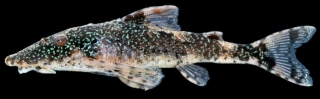
 VEN10-08
 All Fishes Data Sheet All Fishes Data Sheet | |
|---|---|
| Scientific Name | Rhinotocinclus eppleyi (Schaefer & Provenzano, 1993) |
| Common Name | |
| Type Locality | Caño Curicurito, about 1 kilometer above its mouth into the Río Autana, Estado Amazonas, Venezuela, 4°47'N, 67°25'W. |
| Synonym(s) | Parotocinclus eppleyi |
| Etymology | Rhinotocinclus is a combination of the Greek Rhinos meaning beak or snout and Otocinclus, a genus of Hypoptopomatinae, in allusion to the conspicuous and elegant snout of most of its species. Lorica, Loricare = cuirass of corslet of leather (a suit of armour made of leather). |
| Species Information | |
| Size | 30mm or 1.2" SL. Find near, nearer or same sized spp. |
| Identification | Rhinotocinclus is diagnosed from all other genera in Hypoptopomatinae by having the canal cheek plate on the ventral surface of the head posteriorly elongated and contacting the cleithrum (vs. canal cheek plate rounded or mesially elongated and not expanded backwards to contact the pectoral girdle). Rhinotocinclus is diagnosed from all other genera in Hypoptopomatinae by having the canal cheek plate on the ventral surface of the head posteriorly elongated and contacting the cleithrum (vs. canal cheek plate rounded or mesially elongated and not expanded backwards to contact the pectoral girdle). |
| Sexing | Males possess a urogenital papilla immediately behind the anus, and a variably deep skin fold along the first, unbranched pelvic-fin ray (vs. both absent in females). Also, males possess a much larger nostril than females, causing the internarial distance to be smaller in males. The larger size of the olfactory organ of males also causes an elevation in the snout profile immediately in front of the eyes, which can be easily seen in lateral view. In most species, males also possess longer pelvic fins than females, with the males' pelvic fins reaching or almost reach to the anal-fin origin. Males possess a urogenital papilla immediately behind the anus, and a variably deep skin fold along the first, unbranched pelvic-fin ray (vs. both absent in females). Also, males possess a much larger nostril than females, causing the internarial distance to be smaller in males. The larger size of the olfactory organ of males also causes an elevation in the snout profile immediately in front of the eyes, which can be easily seen in lateral view. In most species, males also possess longer pelvic fins than females, with the males' pelvic fins reaching or almost reach to the anal-fin origin. |
| Habitat Information | |
| Distribution | South America Orinoco, Upper Orinoco (click on these areas to find other species found there) Orinoco, Middle Orinoco (click on these areas to find other species found there) Login to view the map. |
| IUCN Red List Category | Not Evaluated |
| Husbandry Information | |
| Breeding Reports | There is no breeding report. |
| Further Information | |
| Reference | Ichthyological Exploration of Freshwaters v. 4 (no. 1), pp 46, Figs. 5-6 |
| Wishlists | Love this species? Click the heart to add it to your wish list. There is no wish to keep this species. |
| Spotters | Spotted this species somewhere? Click the binoculars! There is but a single record of this fish being seen, view it. |
| More Resources | |
| Forum BBCode | |
 | Look up R. eppleyi on PlanetCatfish.com |
 | Look up R. eppleyi on Fishbase |
 | Look up R. eppleyi on Encyclopedia of Life |
 | Look up R. eppleyi on Global Biodiversity Information Facility |
| LFS label creator ARN ref:1.4.1551.5255 | |
| Last Update | Sat Dec 25, 2010 10:17 am (Species record created: Thu Jan 01, 1970 1:00 am) |