
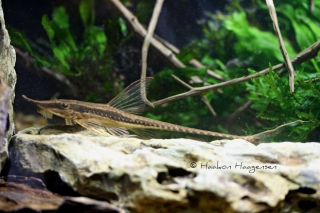
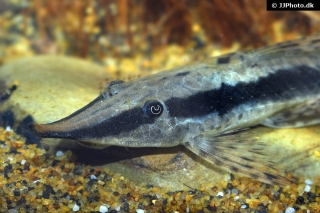
 Close-up of head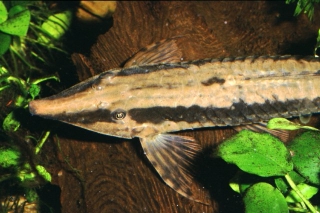
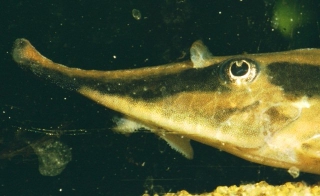 Close-up of head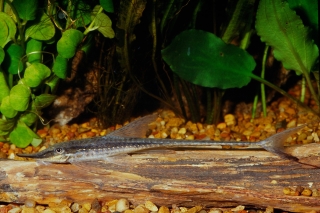
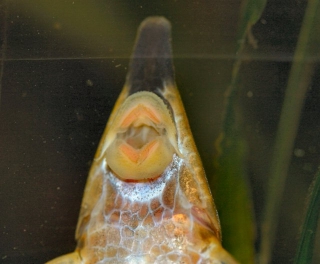
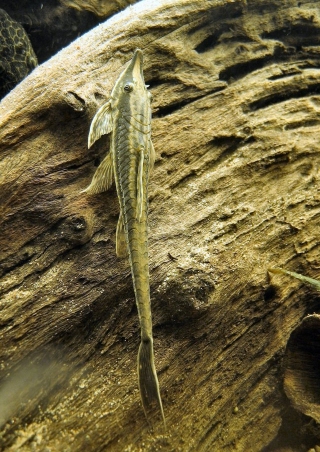
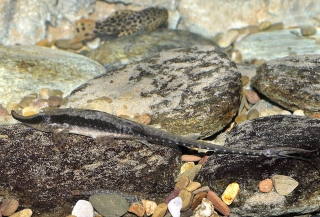
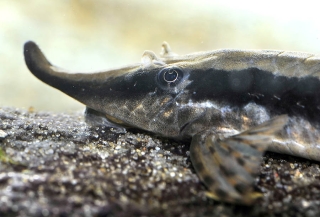 Close-up of head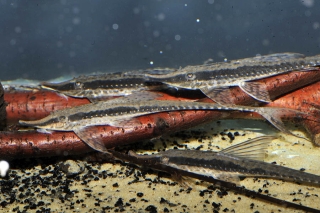
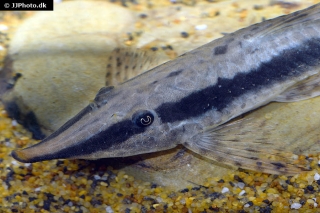 Close-up of head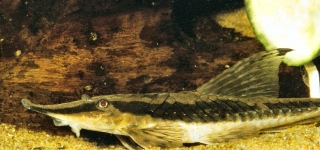
 All Fishes Data Sheet All Fishes Data Sheet | |
|---|---|
| Scientific Name | Sturisoma nigrirostrum Fowler, 1940 |
| Common Names | Blacksnouted Whiptail Nadelstreifen-Bartwels (Germany), Sortsnudet Størsugemalle (Denmark), Whiptail Pleco |
| Type Locality | Contamana, Río Ucayali, Peru. |
| Synonym(s) | Sturiosoma nigrirostrum |
| Etymology | German, sturio = sturgeon, + Greek, soma = body. Lorica, Loricare = cuirass of corslet of leather (a suit of armour made of leather). |
| Species Information | |
| Size | 220mm or 8.7" SL. Find near, nearer or same sized spp. |
| Identification | Sturisoma and Sturisomatichthys can be difficult to tell apart. Older descriptions of the genera emphasized the length of the snout (elongated in Sturisoma), but this trait is not reliable across species. Recent analyses allow discrimination based on the abdominal plates, fin colors and lateral plates: Sturisoma has its central abdominal plates arranged in three clearly-defined longitudinal series; all fins (except sometimes pectoral fins) lack dark spots; and 20–21 lateral plates in median series. Sturisomatichthys has its central abdominal plates less organized, not arranged in clearly-defined longitudinal series; dark spots usually present on one or more of the dorsal-, pectoral-, pelvic, or anal-fins; and 15–18 lateral plates in median series. Furthermore, to date all Sturisoma are cis-Andean; most (but not all) Sturisomatichthys are trans-Andean. Sturisoma and Sturisomatichthys can be difficult to tell apart. Older descriptions of the genera emphasized the length of the snout (elongated in Sturisoma), but this trait is not reliable across species. Recent analyses allow discrimination based on the abdominal plates, fin colors and lateral plates: Sturisoma has its central abdominal plates arranged in three clearly-defined longitudinal series; all fins (except sometimes pectoral fins) lack dark spots; and 20–21 lateral plates in median series. Sturisomatichthys has its central abdominal plates less organized, not arranged in clearly-defined longitudinal series; dark spots usually present on one or more of the dorsal-, pectoral-, pelvic, or anal-fins; and 15–18 lateral plates in median series. Furthermore, to date all Sturisoma are cis-Andean; most (but not all) Sturisomatichthys are trans-Andean. |
| Habitat Information | |
| Distribution | South America Amazon, Upper Amazon, Marañón, Ucayali (click on these areas to find other species found there) Amazon, Upper Amazon, Yavari (click on these areas to find other species found there) Login to view the map. |
| IUCN Red List Category | Least Concern , a distribution map is available on the IUCN species page. Last assessed 2014. |
| pH | 6.0 - 7.0 |
| Temperature | 24.0-28.0°C or 75.2-82.4°F (Show species within this range) |
| Other Parameters | Natural habitat is soft water. |
| Husbandry Information | |
| Breeding Reports | There is no breeding report. |
| Further Information | |
| Reference | Proceedings of the Academy of Natural Sciences of Philadelphia v. 91 (for 1939), pp 249, Figs. 48-50. |
| Wishlists | Love this species? Click the heart to add it to your wish list. There is no wish to keep this species. |
| Spotters | Spotted this species somewhere? Click the binoculars! There are 5 records of this fish being seen, view them all. |
| More Resources | |
| Forum BBCode | |
 | Look up S. nigrirostrum on PlanetCatfish.com |
 | Look up S. nigrirostrum on Fishbase |
 | Look up S. nigrirostrum on Encyclopedia of Life |
 | Look up S. nigrirostrum on Global Biodiversity Information Facility |
| LFS label creator ARN ref:1.4.102.444 | |
| Last Update | Sat Dec 25, 2010 10:17 am (Species record created: Thu Jan 01, 1970 1:00 am) |